Commander & cEDH · Web and iPhone
Your deck knows what it's missing.
Your guild knows who has it.
It plays your Commander deck out turn by turn, then shows which of the missing cards a guildmate already has.
A real deck, already understood
Limit Break, read by the same engine the app runs. Switch tabs, swap in any precon, or paste your own list — no account needed.
Limit Break
Cloud, Ex-SOLDIER
Casual table 6.6/10High power 5.4/10cEDH 6.3/10
What we found in your list — set us straight where we're wrong
From your 100 cards
Suit up the commander and commander damage ends it.
Ramp into Cloud, Ex-SOLDIER.
Early
Put damage on the table early — bodies now, the finish later.
Mid
Get the value engines online — the cards that keep working every turn.
Late
Stop their win. Secure yours.
How this deck wins
- Suits up the commandercounted in your oddsBehemoth Sledge + Summoning Materia + Cloud, Ex-SOLDIER + Skullclamp + Colossus Hammer + Conqueror's Flail + Wrecking Ball Arm + Champion's Helm + Sword of the Animist + Hero's Blade + Hero's HeirloomEquipment and auras make the commander lethal.any of: Behemoth Sledge, Summoning Materia, Cloud, Ex-SOLDIER +8
Repeatable value engines
Draw cards
- Bugenhagen, Wise ElderBugenhagen, Wise Elder
- Bonders' EnclaveBonders' Enclave
Make creatures stronger
- Makes a lethal attackany of: Behemoth Sledge, Tifa, Martial Artist, Summoning Materia +9Heidegger, Shinra ExecutiveHeidegger, Shinra Executive keeps making creatures for Behemoth Sledge to scale with
Play things for cheap
- Cid, Freeflier PilotCid, Freeflier Pilot
Make mana
- Professional Face-BreakerProfessional Face-Breaker
Do their own thing
- Unfinished BusinessUnfinished Business
- Red XIII, Proud WarriorRed XIII, Proud Warrior
- Sephiroth, Fallen HeroSephiroth, Fallen Hero
- Aerith, Last AncientAerith, Last Ancient
- Elena, Turk RecruitElena, Turk Recruit
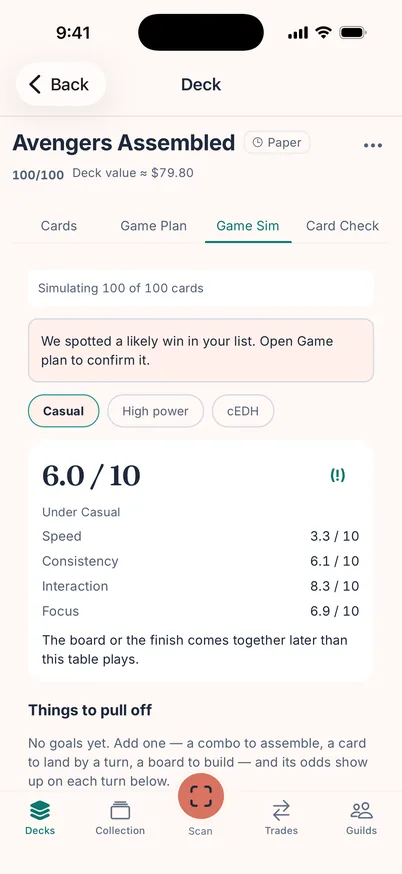
This is the real engine running in your browser, not a screenshot. 1,500 games in the browser, 2,000 on the phone; the shuffle is seeded, so the same list comes back with the same numbers. Casual, high power and cEDH change the opposition — how much interaction you face and how long the game runs. Rates count only the games still going by that turn, and the app says so when few finish lines are modelled, so a low number reads as a blind spot rather than a weak deck.
Screen by screen.
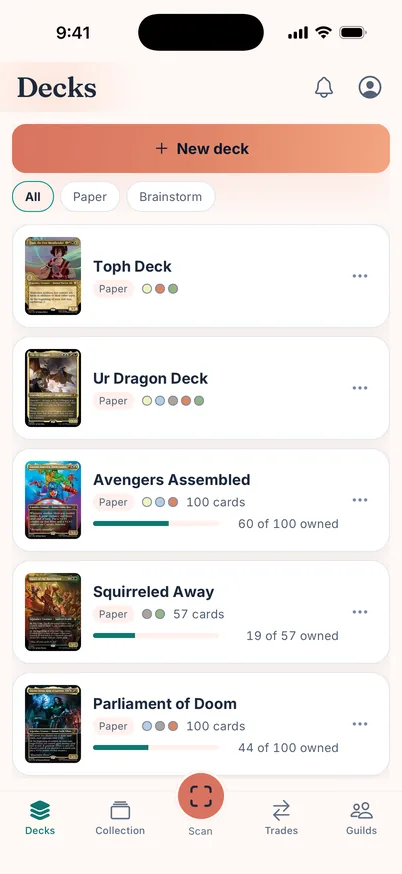
Decks
Every deck, at a glance.
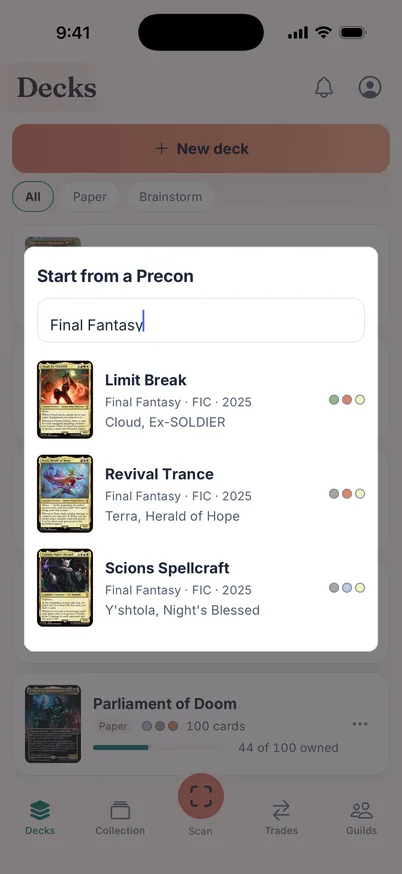
New deck
Start from a precon.
Game Sim
Scored before game night.
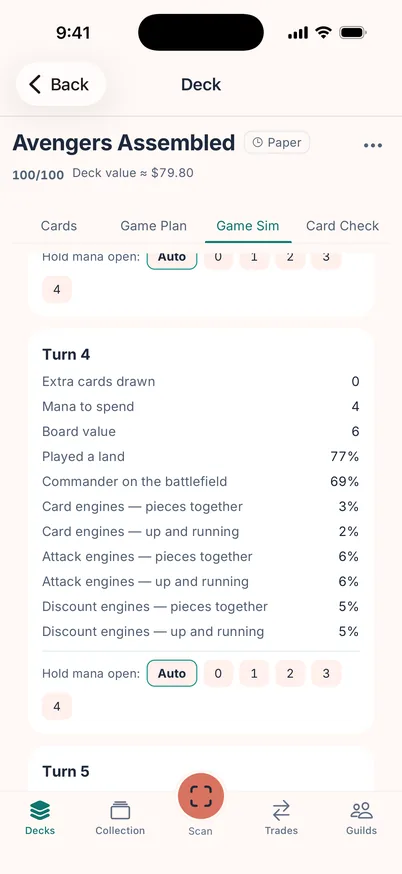
Turn by turn
See turn four before you sit down.
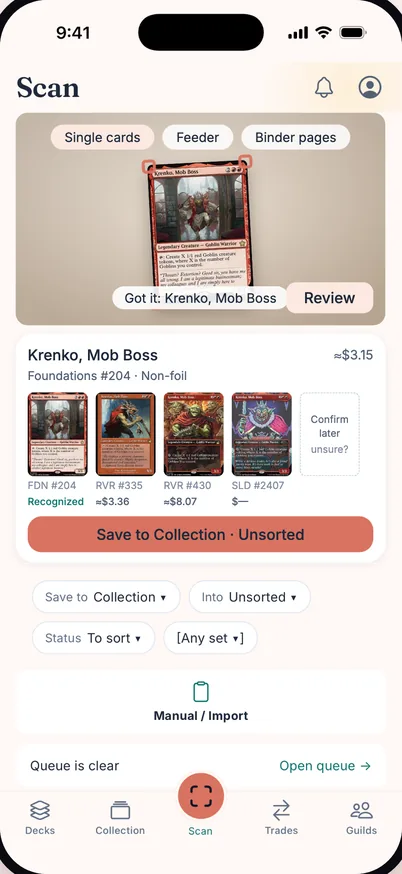
Scan
Point the camera.
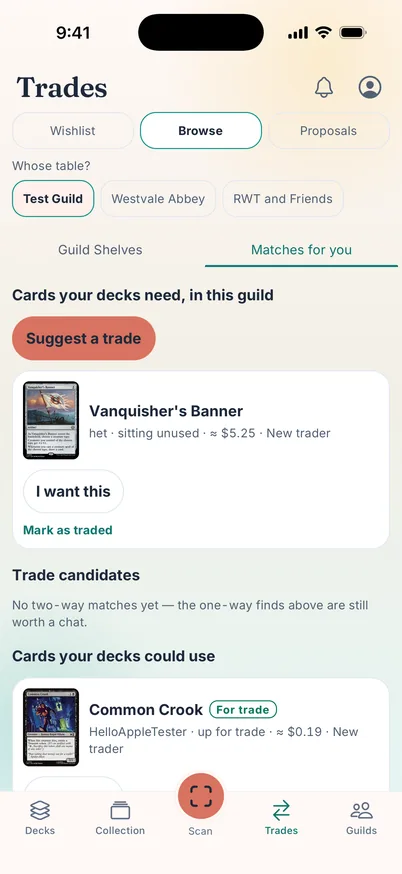
Trades
Find it two seats down.
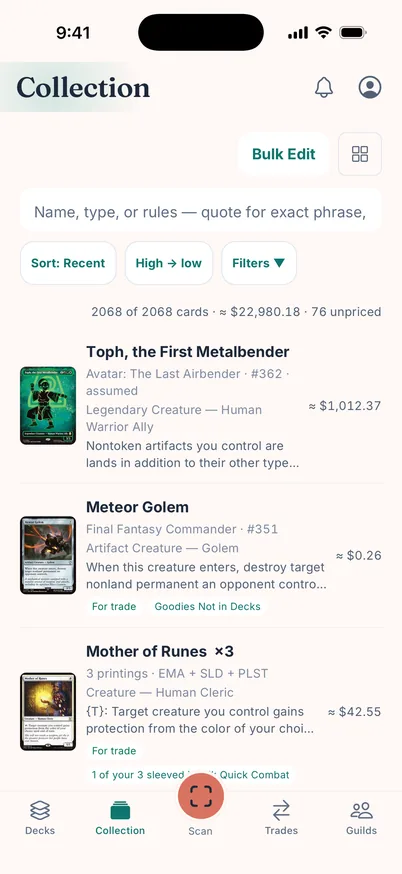
Collection
Every card, and where it lives.
Your guild knows who has them
The cards the engine would add to Limit Break next, matched against the shelves in your guild.
Cards this deck could use, in one guild
 Tireless ProvisionerWould use your extra land plays@maple · up for trade×1
 Karn's BastionWould use your counters@rivertide · could part with it×2
 Beast WhispererWould use your card draw@bruno_g · sitting unused×1
The cards and reasons are the engine's real reading of the demo deck above. The handles are illustrative — real availability comes from the guilds you join.
- Matches run both ways: their spares against your decks, yours against theirs.
- You arrange it here and swap in person. Nothing ships, nobody holds your cards, there is no cut.
Only guilds you join can see your shelf; leave one and they stop that second. Privacy policy →
Sleeves, binders, shop lighting.
Point the camera. It names the card, ranks the printing, and saves only when you confirm.
iPhone only: camera scan, voice logging, offline logging.
35,270
unique cards indexed
112,500
printings, with prices
Daily
catalog sync from Scryfall
0
fees, escrow or shipping
Common questions
A deck simulator and a local trade finder, sharing one collection. It plays your Commander decks out turn by turn so you can see how they actually perform, and it connects you to a local guild (your playgroup, or your LGS) so the cards your decks are short of can come from someone down the road instead of a shipping label. Web and iPhone, one account.
It plays your deck out over a thousand times against a table you pick (casual, high power, or cEDH) and reports, for each turn: how much mana you had to spend, whether you played a land, whether the commander was on the battlefield, and how often there was lethal on board. Every readout states which assumptions produced it. Those are scenario settings, not a measurement of a real metagame.
Keep using them — paste your list straight in from either. They know what's in your deck; TCG Guilds knows which of those cards you physically own, which are already sleeved into another deck, and who near you has the rest. That's the part a deck site structurally can't do.
No. Paste a whole decklist or a CSV, say card names out loud, or photograph cards with the phone camera. Every line is matched to a real card, and you get to correct anything it gets wrong before it's saved. You can start with one deck and never touch the shoebox.
Members of a guild you have joined, and anyone you send a shelf link to. If you're not in a guild and you haven't shared a shelf link, nobody sees anything. Join a guild and your cards become searchable by that guild's members; leave and they stop seeing them immediately. A shelf link shows the same up-for-trade slice to anyone with the URL until you pause or stop it. How many copies you own, where they're stored and any notes stay hidden unless you turn on full detail for that guild, and what you'd sell a card for is never shown to anyone at any setting.
Mark spare cards for trade, for sale, or flex and they go on your shelf. TCG Guilds reads every guildmate's shelf against every one of your decks and shows both directions: cards you need that they have, and two-way matches where each of you holds something the other wants. You arrange it before you meet and swap in person — we never handle the cards, take a cut, or hold anything in escrow.
The free tier covers 3,500 cards and 5 decks — the core collection tracker stays free. Premium lifts those caps for $3.99/month or $39.99/year, billed by Apple through the App Store on iPhone (one account, so the upgrade follows you to the web).
No. TCG Guilds is unofficial Fan Content permitted under the Wizards of the Coast Fan Content Policy — it is not approved or endorsed by Wizards. Card data and images come from Scryfall.
Start with one deck
Paste a decklist and watch it play out. Two minutes, no scanning.
Free tier: 3,500 cards and 5 decks. Import 3,500+ cards to unlock 3 months of Premium.